Popcorn Ceiling Removal Cost in 2026:
$1.50 to $4.50 Per Square Foot
The most disliked ceiling finish from a generation of US home construction, and one of the most expensive to remove because pre-1980 popcorn typically contains asbestos. Here is the test-before-disturb protocol, the scrape vs cover-over decision, and the pricing for both paths.
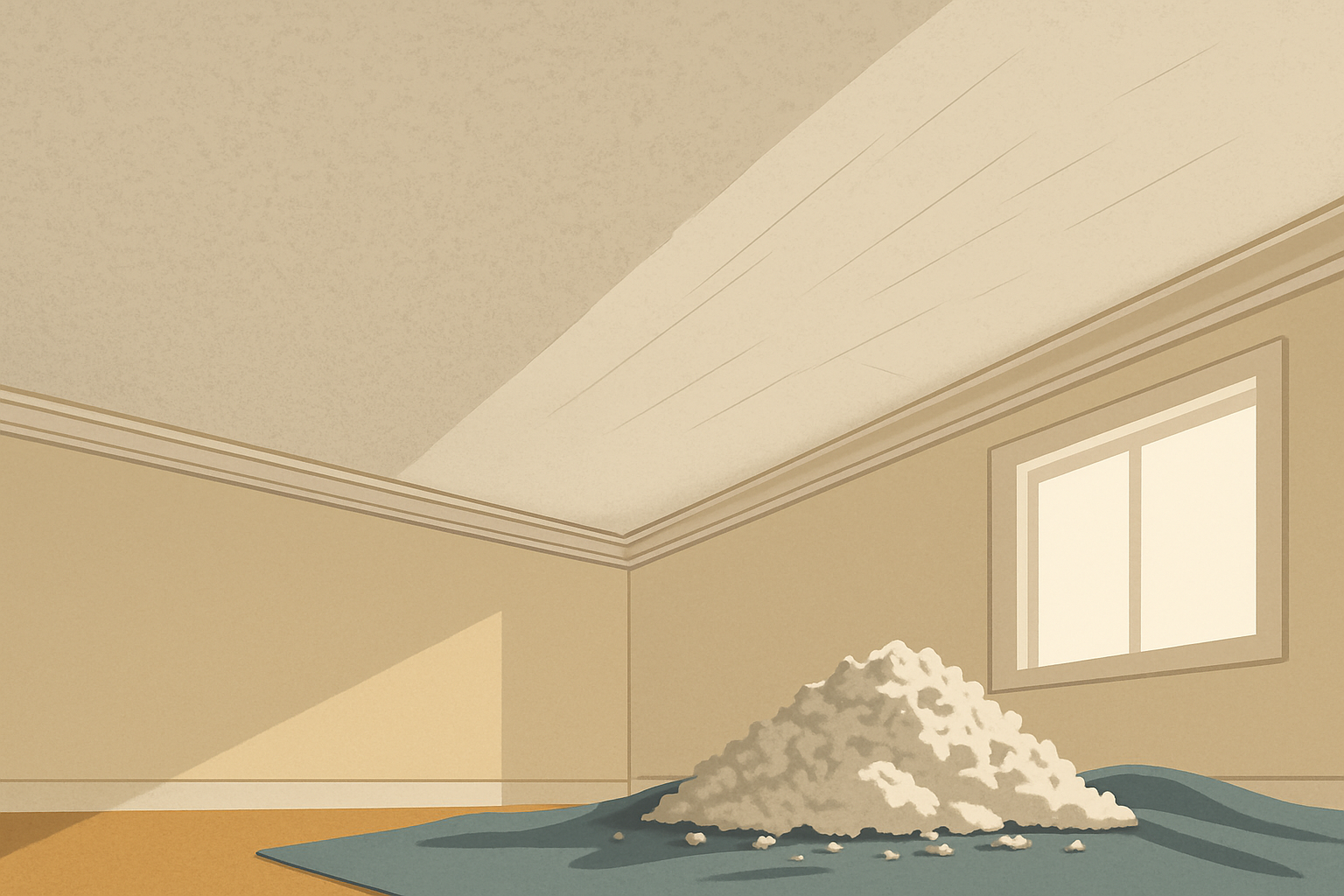
The Asbestos Test Is Step Zero
Before any work begins on a popcorn ceiling installed before 1980, an asbestos test is legally required by federal EPA NESHAP regulations (40 CFR Part 61, Subpart M). Most state and local jurisdictions further require testing on any ceiling installed before the mid-1980s, since asbestos-containing texture was sold and installed through approximately 1985.
The test process is straightforward: a certified asbestos inspector or an EPA-approved testing lab takes a small sample of the texture (a coin-sized piece from an inconspicuous area) and tests it by polarised light microscopy. The result comes back as percentage of asbestos content. Anything above 1 percent is regulated and requires licensed abatement; below 1 percent can typically be removed using standard renovation practices.
Cost of the test: $30 to $80 if you take the sample yourself and mail it to a lab (recommended labs include EMSL, EMLab P&K, and ALS for residential testing). $200 to $500 if you have a certified inspector come to your home to take the sample. The DIY sampling option is legal and accepted by remediation contractors as long as you follow the lab's sampling protocol (wet the texture, use sealed sample container, document the sampling location).
Path A: Scrape (Non-Asbestos Ceiling)
For confirmed non-asbestos popcorn ceilings (post-1985 construction, or pre-1985 ceilings that tested negative), standard scraping is the most common removal method. The process:
- Cover the floor with thick plastic sheeting (6 mil or thicker), extending to the walls. Cover walls with thinner plastic up to about 4 feet for splatter protection.
- Tape off doorways with plastic sheeting to contain dust to the work area. Cover any remaining furniture with old sheets.
- Mist the ceiling with a garden pump sprayer using water with a small amount of dish soap. Wet thoroughly, wait 15 minutes, mist again. This softens the texture and reduces airborne dust during scraping.
- Scrape with a 4-inch or 6-inch drywall knife held at a 30-degree angle. Work in 2-foot square sections. The wet texture comes off in thick sheets onto the plastic below.
- Repair any gouges in the underlying drywall where the scraper bit too deep. Light skim coats of joint compound, sand smooth.
- Apply primer to the now-bare drywall surface. PVA primer or specialty ceiling primer.
- Apply finish texture or smooth paint. Most homeowners choose smooth painted ceiling. Some prefer a light texture (orange peel, knockdown) to hide minor imperfections.
Time investment: a 200 sqft bedroom ceiling takes 4 to 8 hours of active labour for DIY (most of it cleanup), 2 to 4 hours for a pro crew. Calendar time: one day for DIY, half day for pro (the painter then needs another day for the ceiling finish).
Professional cost for the scrape-and-finish: $1.50 to $4.50 per square foot, all-in. On a 200 sqft bedroom, that is $300 to $900. On a 1,000 sqft scope (multiple rooms), $1,500 to $4,500. The high end of the range reflects coastal metros (Bay Area, NYC, LA) and the low end reflects rural and lower-COL areas.
Path B: Cover-Over (1/4 Inch Drywall Skin)
For homes with asbestos-containing popcorn (where abatement would be expensive) or for homes with substantial ceiling damage that scraping would expose, the cover-over method is the alternative. A new layer of 1/4 inch drywall is screwed over the existing popcorn ceiling, sealing the texture in place and providing a new smooth surface to finish.
Cover-over advantages: avoids asbestos disturbance entirely (the existing popcorn stays in place and is sealed beneath the new drywall), provides a perfectly smooth substrate for paint, hides any existing ceiling imperfections, and is dramatically less messy than scraping. Disadvantages: adds 1/4 inch to ceiling height (which can cause issues with crown molding, ceiling fixtures, and tall furniture clearance), is slightly more expensive than DIY scraping (though comparable to professional scraping), and requires re-trimming around any ceiling-mounted fixtures.
For asbestos-containing ceilings, the cover-over method is often the right call from a cost-benefit standpoint. Compare: scrape with asbestos abatement at $5 to $15 per sqft, versus cover-over at $2.50 to $5.50 per sqft with no asbestos disturbance. On a 1,000 sqft scope, that is $5,000 to $15,000 for abatement-scrape versus $2,500 to $5,500 for cover-over.
Cover-over technique uses 1/4 inch drywall ("bender board" not required, standard 1/4 inch is fine for flat ceilings) screwed through the existing popcorn into the ceiling joists. Screws should be at least 2 inches long to penetrate through the new drywall, through the popcorn-coated original ceiling, through the original drywall, and at least 3/4 inch into the joist. Standard joint compound finishing follows. See 1/4 inch drywall cost for material pricing.
Cost Breakdown by Room Size
| Room | Ceiling area | Scrape (non-asbestos) | Scrape (with abatement) | Cover-over |
|---|---|---|---|---|
| Small bedroom (10x12) | 120 sqft | $180 to $540 | $600 to $1,800 | $300 to $660 |
| Large bedroom (12x14) | 168 sqft | $250 to $756 | $840 to $2,520 | $420 to $924 |
| Living room (16x20) | 320 sqft | $480 to $1,440 | $1,600 to $4,800 | $800 to $1,760 |
| Whole house (2,000 sqft floor) | ~1,800 sqft (excludes closets) | $2,700 to $8,100 | $9,000 to $27,000 | $4,500 to $9,900 |
The asbestos abatement column shows why the test is so important. For a whole-house popcorn removal, the difference between non-asbestos scrape ($2,700 to $8,100) and abatement-scrape ($9,000 to $27,000) is $6,300 to $18,900. Even the cover-over alternative ($4,500 to $9,900) is dramatically cheaper than abatement. The $30 to $80 asbestos test cost is the single most cost-effective expenditure in this entire workflow.
DIY Popcorn Removal (Non-Asbestos Only)
For confirmed non-asbestos ceilings (post-1980 typically), DIY scraping is feasible and saves substantial labour cost. The technique is mostly cleanup management, not skilled craft.
DIY material needs: 6-mil plastic sheeting for floor and walls ($25 to $40), garden pump sprayer ($15 to $25), 6-inch drywall knife ($10), 4-inch drywall knife ($8), drop cloths ($15), painter's tape ($10), N95 respirator and safety glasses ($15), joint compound for repairs ($10), drywall primer ($20). Total under $150 for the equipment.
Time investment: a 200 sqft single-room scrape takes 4 to 8 hours for first-time DIY (most of it setup and cleanup). The actual scraping is 1 to 2 hours. Cleanup is the hard part because the wet popcorn debris is heavy and messy. Plan to fill 3 to 5 contractor trash bags with debris from a single bedroom scrape.
The downside of DIY scraping: gouges in the underlying drywall are common, particularly along joints where the scraper catches the tape. Plan to do mud touch-up work on 5 to 15 percent of the ceiling surface. The skim coat work to hide these gouges takes another 2 to 4 hours of finisher labour spread over 2 to 3 days for mud drying.
Net DIY savings: a 200 sqft bedroom scrape costs roughly $50 to $80 in materials (excluding primer and paint) versus $300 to $900 for a professional, a savings of $250 to $850. Worth it for handy homeowners, marginal for time-constrained ones.
Retexture Options After Scrape
After scraping, you have three finish options for the ceiling. Each has different cost and visual impact.
- Smooth painted (most popular). Skim coat any gouges, sand smooth, prime, paint two coats. Adds $0.50 to $1.50 per sqft over the bare scrape cost. Modern aesthetic, what most homeowners want.
- Light texture (orange peel). Spray-applied fine texture after the smooth-paint preparation. Adds $0.75 to $1.25 per sqft. Hides minor imperfections, common in builder-grade construction.
- Knockdown texture. Heavier texture for a Mediterranean or Southwest aesthetic. Adds $1.00 to $1.75 per sqft. Hides moderate imperfections.
Smooth painted is the dominant choice for modern remodels (90+ percent of post-2010 popcorn removals end with smooth painted ceilings). The texture options are appropriate when the underlying ceiling has too many imperfections to skim-coat smoothly, or for specific aesthetic reasons. For full texture pricing see drywall finishing cost.
Frequently Asked Questions
How do I know if my popcorn ceiling has asbestos?
If your home was built before 1985, you must assume yes until tested. The test is mandatory under EPA NESHAP for any pre-1980 popcorn and strongly recommended for 1980 to 1985. Take a small sample yourself and mail to a lab for $30 to $80.
Can I just paint over popcorn ceiling?
Possible but rarely satisfying. Paint highlights every imperfection in the popcorn texture, and the porous popcorn absorbs paint unevenly. Most homeowners find the painted result still looks dated and choose to remove or cover instead.
Does popcorn ceiling removal increase home value?
Modestly. Popcorn removal is not a tracked line item in appraisal-based remodel value reports, but real estate agents and home stagers generally estimate it recovers roughly 60 to 75 percent of its cost at resale when done cleanly. The bigger impact is on time-on-market and buyer perception; popcorn ceilings are widely seen as dated and trigger price-reduction requests during negotiation.
Should I scrape or cover-over my popcorn ceiling?
Three considerations. If asbestos-positive, cover-over is usually cheaper than abatement scrape. If your ceiling height is below 8 feet, scrape is preferred to preserve clearance. If the underlying drywall is in good condition, scrape works well. If the drywall is damaged or in poor shape, cover-over is the right call.
How long does popcorn ceiling removal take?
Per room: 1 to 2 days for scrape-and-finish, 2 to 3 days for cover-over (because of mud cycles for the new drywall). Whole house: 1 to 2 weeks for scrape, 2 to 3 weeks for cover-over. Plus 1 to 2 weeks of permit lead time in jurisdictions that require permits.