1/2 Inch Drywall Cost in 2026:
$12 to $18 Per Sheet (Standard Interior Board)
The default board for most interior residential walls. Per-sheet pricing across the three sub-types (regular, ultralight, moisture-resistant), where 1/2 inch is the right spec, where building code forces you to upgrade, and how to read a quote that says "1/2 inch standard."
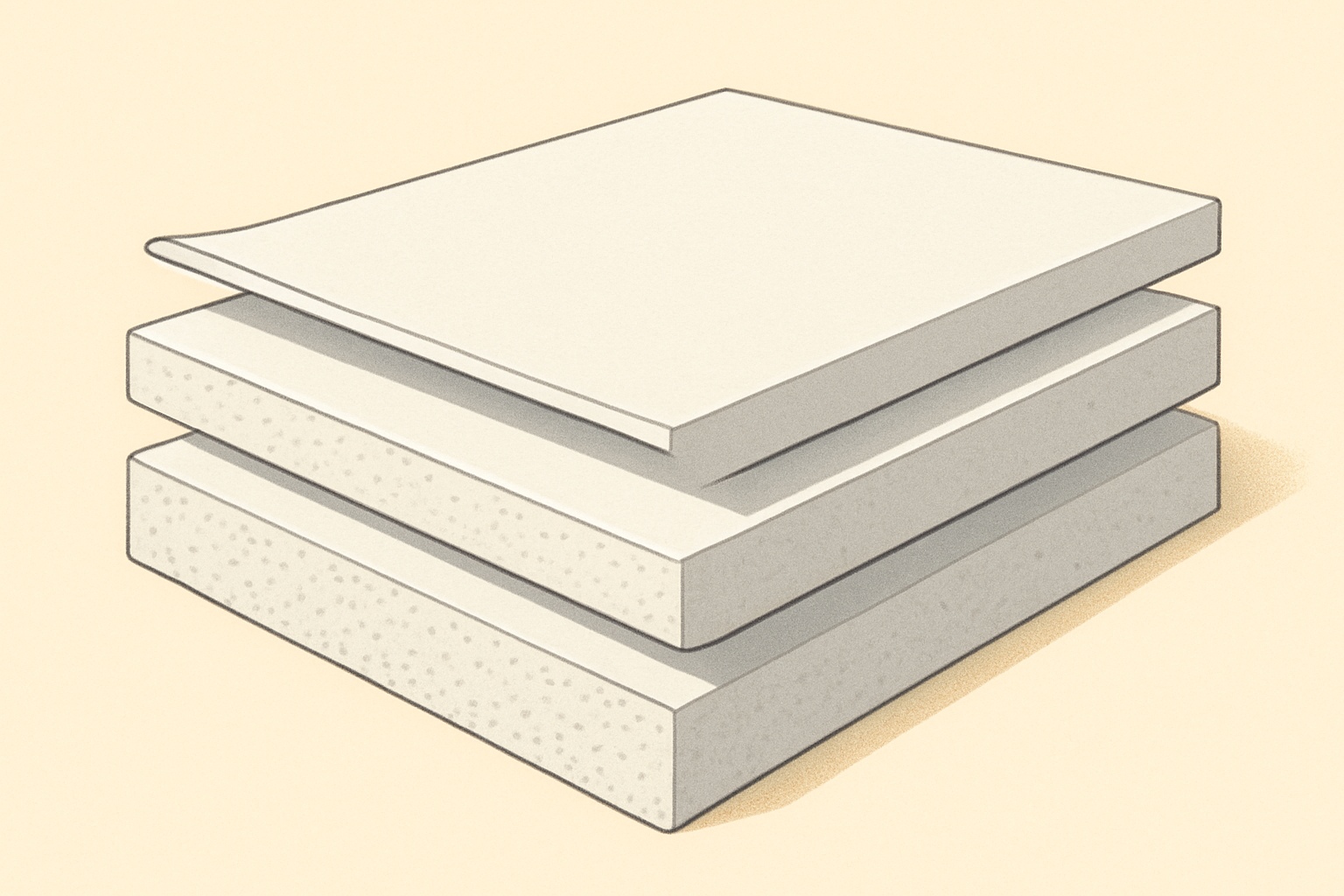
The Three Variants of 1/2 Inch Drywall
"1/2 inch drywall" at the home centre is not one product. It is a category of three distinct sheet types, each priced and used differently.
| Type | Per 4x8 sheet | Sheet weight | Primary use |
|---|---|---|---|
| Regular 1/2" | $12 to $15 | 54 lb | Standard interior walls, ceilings under 16 inch joist spacing |
| Ultralight 1/2" | $15 to $18 | 38 lb | DIY-friendly, same finish quality, easier overhead work |
| Moisture-resistant 1/2" (green) | $16 to $20 | 57 lb | Bathrooms, laundry, basement exterior walls |
| Mould-resistant 1/2" (purple) | $18 to $22 | 55 lb | High-humidity basements, behind tile in showers (with separate vapor barrier) |
Pricing snapshot from Home Depot and Lowe's national listings, April to May 2026. Home Depot drywall category, Lowe's drywall category.
Where 1/2 Inch Is the Right Spec
Regular 1/2 inch drywall is correct for most interior residential applications. Bedroom walls, living room walls, dining rooms, hallways, closets, home offices. Any wall between two interior rooms in a single-family home is almost always specified at 1/2 inch standard. The default expectation in a residential construction quote is 1/2 inch standard unless otherwise specified.
For ceilings, 1/2 inch is also the standard, but only when joists are spaced 16 inches on centre or closer. Joists at 24-inch on centre spacing should use 5/8 inch drywall to prevent sagging over time. Most pre-1990 homes use 16-inch joist spacing, so 1/2 inch is fine. Newer engineered-joist construction often uses 19.2 or 24-inch spacing, which forces the upgrade to 5/8 inch on ceilings. Check your joist spacing before ordering.
Moisture-resistant 1/2 inch (green board) is the right choice in bathrooms, laundry rooms, mudrooms, and any basement wall below the ground line. The premium is $4 to $7 per sheet, or about $0.13 to $0.22 per square foot. For a small bathroom with 200 sqft of drywall surface, that adds $26 to $44, an easy upgrade.
Mould-resistant 1/2 inch (purple board, USG Sheetrock Mold Tough or equivalent) is the premium tier for high-humidity environments. It costs $2 to $4 more per sheet than green board. The right specification for full-basement finishes in flood-prone areas, behind-tile shower substrate (in conjunction with a vapor barrier), and any room with chronic humidity issues. For full pricing detail see moisture-resistant drywall cost.
Where 1/2 Inch Is Not Allowed (Code Forces an Upgrade)
The International Residential Code (IRC) and most state and local codes require thicker, fire-rated drywall in specific locations. Trying to use 1/2 inch in these locations will fail inspection and require redo.
- Garage walls and ceiling adjacent to living space (IRC R302.6). Walls between an attached garage and any habitable room require 1/2 inch Type X fire-rated drywall minimum, with 5/8 inch Type X required on ceilings of garages with habitable space above. Most contractors use 5/8 inch Type X on both walls and ceiling to simplify procurement.
- Party walls in attached homes. Townhouses, condos, and duplexes require fire-rated assemblies between units, typically 5/8 inch Type X on each side of the party wall.
- Apartment occupancies. Most multi-family construction requires 5/8 inch Type X throughout, particularly on corridor walls and unit-to-unit walls.
- Ceilings with engineered joists at 24-inch spacing. Sag-resistance requires 5/8 inch board (or specialty sag-resistant 1/2 inch board, often marketed as "ceiling board").
- Furnace room and water heater enclosure walls. Some jurisdictions require fire-rated enclosures around fuel-burning appliances.
For full pricing on the required upgrade, see 5/8 inch Type X drywall cost. The upgrade is about $5 to $9 per sheet, or $0.16 to $0.28 per square foot.
Total Installed Cost for 1/2 Inch Drywall
Sheet price is one input. Total installed cost for 1/2 inch drywall is the published $1.50 to $3.50 per square foot, which includes the board, all consumables (mud, tape, screws, primer), labour for hanging, labour for finishing to Level 4, cleanup, and disposal. For project sizes from a single room up to a whole house, see the per-sqft size pages: 100, 500, 1,000, 2,000, and 3,000 sqft.
For DIY installers buying only the board, sheet count is calculated as (total surface area / 32 sqft per sheet) plus 10 to 15 percent waste. A 12x12 bedroom with 8-foot ceilings has 520 sqft of surface, which needs 18 sheets. At $12 to $15 per sheet, that is $216 to $270 in board alone. Add another $80 to $120 for mud, tape, screws, and primer, and you have a $300 to $400 materials budget for the DIY hang of a typical bedroom.
Regular vs Ultralight: When the Upgrade Is Worth It
Ultralight 1/2 inch drywall (USG Sheetrock UltraLight, CertainTeed ProRoc Brand Lightweight, others) is roughly 30 percent lighter than regular 1/2 inch (38 pounds versus 54 pounds for a 4x8 sheet). It costs $3 per sheet more, or about $90 to $120 extra on a 30-sheet job. The same fire performance, the same finish quality, the same handling characteristics during finishing. The weight saving matters in three scenarios.
First, DIY installers. Hanging drywall solo is a physical challenge with regular 1/2 inch. Ultralight makes it possible for a single person to manage sheets that would otherwise need two. If you are DIYing, the ultralight upgrade is worth every dollar.
Second, ceiling work. Hanging a 54-pound regular sheet on a ceiling is the most physically demanding part of drywall installation. Ultralight at 38 pounds is dramatically easier and reduces injury risk. Most pro crews now use ultralight on ceilings even when they use regular on walls.
Third, upper floors and stair-access projects. Carrying drywall up two flights of stairs is exhausting with regular sheets. Ultralight saves about 15 minutes per sheet of stair work. On a 35-sheet upper-floor job, that is 9 hours of stocking labour, worth the $100 to $120 premium ten times over.
Frequently Asked Questions
Does 1/2 inch drywall meet building code?
For most interior residential walls and ceilings with 16 inch joist spacing, yes. Garages, party walls, and ceilings with wider joist spacing require 5/8 inch fire-rated or sag-resistant board.
What is the heaviest 1/2 inch drywall sheet?
Standard regular 1/2 inch at 54 pounds for a 4x8 sheet. Moisture-resistant green board is similar at 57 pounds. Ultralight versions weigh 38 pounds. Always check the package weight before buying if you are loading sheets solo.
Can I use 1/2 inch drywall in my garage?
Only on walls that do not separate the garage from living space. The wall between the garage and any habitable room must be 1/2 inch Type X minimum, with 5/8 inch Type X required for ceilings of garages with living space above.
Is 1/2 inch drywall fire-resistant?
Standard 1/2 inch board is not fire-rated. For fire-rated applications, specify 1/2 inch Type X (special core formulation, less common) or upgrade to 5/8 inch Type X. The Type X designation is what indicates fire resistance, not the thickness.
What is the difference between green board and purple board?
Green board (USG Sheetrock Moisture Resistant or similar) is paper-faced with treated paper to resist humidity. Purple board (USG Sheetrock Mold Tough or similar) is fiberglass-faced or has antimicrobial treatment for higher mould resistance. Purple board costs about $2 to $4 more per sheet.